Your swings keep landing in the net or sailing long, and that is frustrating. Here is how to spike a volleyball: take a three-step approach, jump so the ball sits in front of your hitting shoulder, and swing your arm fast.
This guide sits inside our wider set of volleyball training tips, which shows where hitting fits in a full practice plan.
| Item | Value |
|---|---|
| Standard approach length | Three steps |
| Right-hander’s step order | Left-right-left |
| Angle of your final steps to the net | Almost a 45-degree angle |
| Starting set height for practice | 2-meter high balls |
| Where to start hitting in practice | The 3-meter line |
These figures come from AVP’s hitting primer and USA Volleyball’s guide to spiking harder. Coaching advice changes, so check the sources before you rely on them.
Build the approach: footwork that sets up the jump
The run-up that carries you to the ball is your approach, and a clean one makes the jump and swing possible. As AVP’s hitting primer explains, the standard approach is three steps. Right-handers step left-right-left, while lefties are the opposite, with right-left-right.
Some hitters run a longer pattern, and AVP notes that a four-step or more approach is common. Even then, the final three steps stay the same, so you can lengthen your run-up as you improve without rebuilding your takeoff steps.
Here is how the footwork breaks down:
- Wait in a ready stance. Keep your knees and upper body bent, with relaxed arms, so you can spring into action the moment the set leaves your teammate’s hands.
- Take a big first step toward the ball. It is powerful and assertive, and it decides where the rest of your approach goes.
- Close with two fast steps. They land side by side, about shoulder-width apart, to build your jumping base.
- Turn toward the set. Your hips and chest open up to the ball before you leave the ground.
Those last two steps should turn you toward the set at almost a 45-degree angle to the net, according to AVP. The slow-then-fast rhythm matters more than raw speed, because a rushed first step leaves you off balance at takeoff.
Jump so the ball sits in front of your hitting shoulder
Where you leave the floor decides where the ball ends up. USA Volleyball says hitting with power requires the ball to be in front of your shoulder. If it drifts too far ahead, you keep the power but will likely not get the ball over the net.
The opposite mistake costs you in a different way. Let the ball fall too far behind you and it clears the net but loses a large amount of power. Some players then arch their backs to chase the ball, and USA Volleyball links that habit to lower-back injuries.
Aim for a neutral position, with the ball falling directly in front of your hitting shoulder. From there you can choose to hit line, cross-court or cut, so the blocker has to guess. If you keep ending up under the ball, start your jump a little further back and drift less toward the net.
Your arms help the jump as much as your legs do. AVP tells hitters to swing the arms forward and up as they leave the ground to increase jump height. It also reminds you that you are jumping up, not forward.
Contact comes at the top. ACTIVE places the contact point slightly in front of and as high as possible above the hitting shoulder, and warns that touching the net during the attack is a net violation.
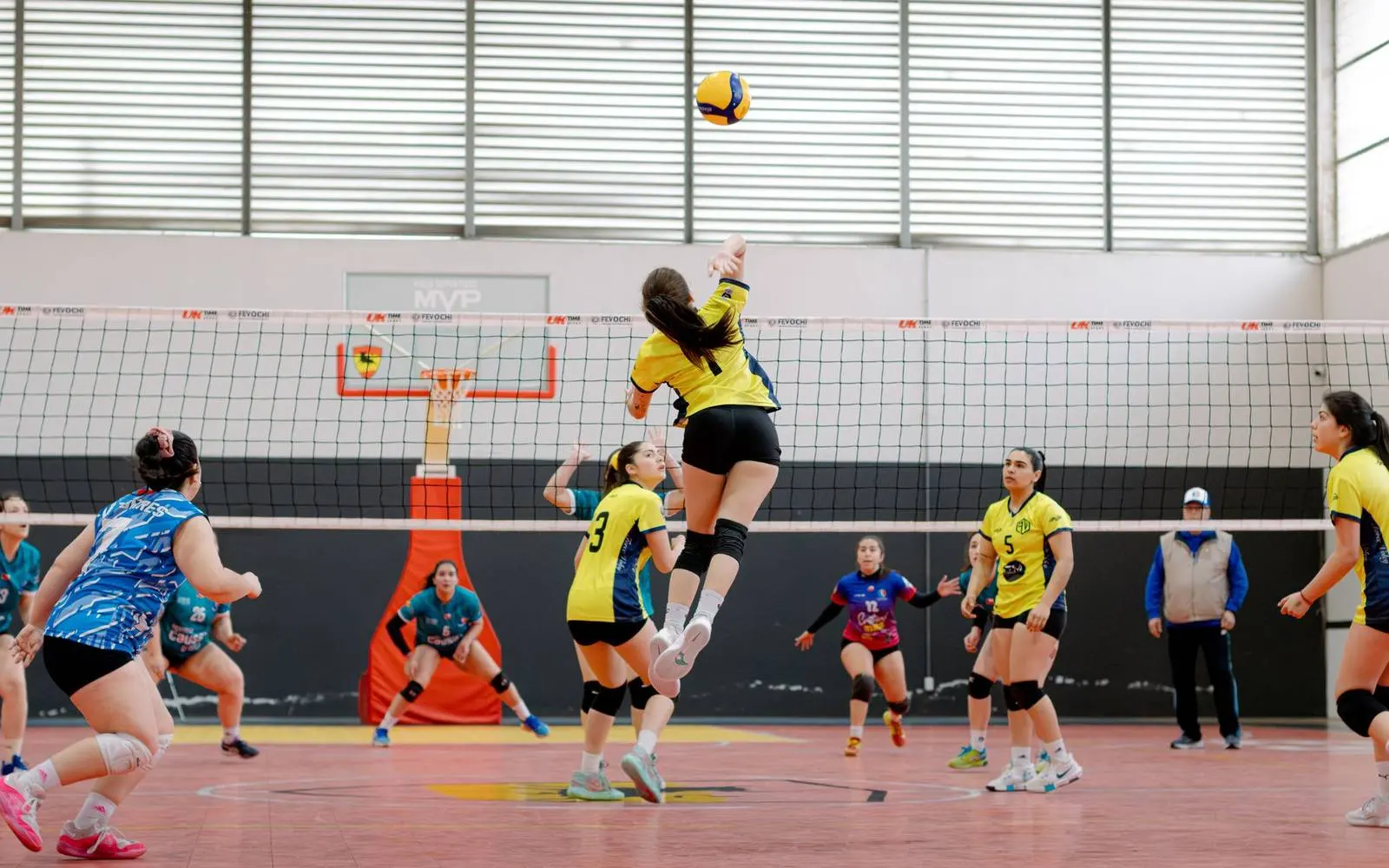
How do you swing faster and hit through the ball?
Many players try to hit harder and end up slower. USA Volleyball says that to hit the ball harder you just need to swing your arm faster. Trying to force power tightens the muscles of the shoulder girdle, so you cannot unleash your fastest arm swing.
Once you are in the air, the swing follows a simple pattern:
- Load. Pull the hitting arm back and keep the hand at shoulder height or higher, as ACTIVE describes.
- Bow and arrow. AVP describes a stance where your non-hitting hand tracks the ball while the hitting hand is cocked back, ready to swing (source).
- Strike. Hit on top of the ball with a big, wide hand and follow through in a downwards motion to put spin on it.
- Finish. Let the arm whip through and slow down naturally near your waist.
The twisting action matters too. USA Volleyball calls it opening the door and slamming it: you open up after takeoff, then close off with as much power and speed as you can. Like the arm swing, this timing takes a long period to learn for most players.
Most coaches also keep the elbow high. Wikipedia’s overview of spiking notes that a regular spike keeps the elbow above the shoulder through the entire swing.
A practice plan you can run this week
Start with solo reps that need no court. AVP’s advice is to practice your arm swing against a wall, then throw the ball to yourself and hit it over the net (AVP).
Next, move to the net, but not onto it. USA Volleyball says the best way to learn is to first hit 2-meter high balls from the 3-meter line, then move closer as practice and the season develop. Hitting on the net is easier to block and causes more ankle sprains when the set drifts too close.
Finally, hit real sets from a teammate. The same source says the best way to learn timing is to hit real set balls so you can time them. A simple weekly order looks like this:
- Footwork only, with no ball, until the rhythm feels automatic.
- Wall or self-toss swings for arm speed.
- Live sets from the 3-meter line, moving closer when the contact feels clean.
- A few full-speed swings with no worry about where they land.
Work through volleyball drills for beginners alongside this plan, so your passing and setting stay steady enough to feed your hitting. ACTIVE says the approach for the spike is the same as in jump serving, so it also pays to read up on how to serve a volleyball when you want a second use for your footwork.
V-League.org is an independent resource and is not affiliated with any league, federation or governing body.
Common spiking mistakes and quick fixes
Most hitting problems trace back to one of a few habits. Check yourself against this list after each session:
- Stopping the arm early. USA Volleyball says too many players slow or stop their arms after hitting the ball (source). Whip through instead.
- Squeezing for power. Tension in the shoulders makes the swing slower, so keep the arm loose and let speed do the work.
- Jumping forward. Drive up, not into the net, so you can contact the ball high and stay clear of a violation.
- Arching to rescue a bad jump. Fix the takeoff spot instead of bending backward to find the ball.
- Waiting for perfect accuracy. Speed comes first, and placement improves with repetition.
Frequently asked questions
Do you take off from one foot or two?
Show answer
Most spikers leave the floor from both feet, and ACTIVE’s step-by-step breakdown teaches a two-foot jump with the arms swung up high. The exception is the slide, an attack where only one foot is used for take-off, as described on Wikipedia.
Is a spike always the third contact?
Show answer
Usually, though not by rule. A University of Georgia course text says a spike is typically the third touch by a team, with the hitter driving the ball quickly onto the opponent’s court (UGA).
What if my fast swings keep missing the court?
Show answer
Stay patient and keep the speed. USA Volleyball argues that accuracy should be sought with speed, not at the sacrifice of speed, and that it grows over time as you keep swinging.
What can I do when the block is up?
Show answer
Change the shot rather than the effort. Wikipedia describes a dink, also called a poke, as tipping the ball over the blocker’s hands onto an open area behind them.