Nervous about your next serve? Here is how to serve a volleyball: start with a firm underhand, make clean contact with a flat hand, then add an overhand float and a jump serve.
When your serve feels steady, browse more volleyball training tips to keep improving.
| Item | Value |
|---|---|
| Jump float net clearance | A foot or two at the most |
| Jump float error-rate target | Lower than 10 percent |
| Jump serve set-up | Four large steps back from the end line |
| Jump serve toss | About 2 meters into the air and 2 meters in front |
| Topspin jump serve approach | 3-step approach |
These figures come from USA Volleyball’s jump float feature and Volleyball World’s jump serve tutorial. Coaching advice and recommendations can change, so check the sources before you rely on them.
Start with clean contact, not a fancy routine
Before you chase power, work on contact. Coach Hugh McCutcheon says in a USA Volleyball feature that contact is the place to start, with a flat, tight hand meeting the middle of the ball.
He suggests building a serve in this order:
- Learn to hit the ball well and consistently.
- Add range: different directions, trajectories and distances.
- Only then settle on a pre-serve routine.
Skipping ahead causes bad habits. McCutcheon warns that players who focus on routine alone may strike the ball with the thumb or another part of the hand, and they will not become good servers (USA Volleyball).
What makes a serve legal?
A serve starts every point, so know what counts as playable before you drill. The University of Georgia’s open volleyball chapter lists the basics:
- Stand behind the end line, anywhere along your side of the court.
- Contact the ball before stepping on or over the end line.
- Send the ball over the net and into the opponent’s court.
A ball that clips the net and still drops into the opponent’s court is good. If it hits the net and comes back onto the serving team’s court, it is an illegal serve and the opponent gets the point (University of Georgia). Volleyball World adds that a foot fault hands your opponents a penalty side-out, as described in its jump serve tutorial.
Underhand serve: the easiest place to begin
The underhand serve is usually the easiest to learn, and beginners often place it more accurately, according to the University of Georgia chapter. Use these steps from that source:
- Stand with your non-dominant foot in front.
- Hold the ball loosely at hip height in your non-dominant hand.
- Make a fist with your dominant hand and rotate the arm so the heel of the hand faces up.
- Draw the serving arm back.
- Swing forward and hit the ball off your other hand, like a golf tee.
- Follow through with the arm.
Treat this serve as your safety net. Polish it first, so a bad overhand day never leaves you without a serve you trust.
Overhand and float serves
An overhand serve brings more speed and power than an underhand, though it is often harder to aim, says the University of Georgia chapter. For a standing version, the same source gives this sequence:
- Step forward with the foot opposite your serving hand.
- Toss the ball 3-4 feet above your head.
- Pull the serving arm back into a bow-and-arrow shape.
- Contact the ball with an open palm.
- Follow through and move your weight from back to front.
The float serve uses the same motion, but you add no spin with the toss and your hard, open hand stops at contact, like an exaggerated high five. The ball then wobbles and is hard for opponents to read (University of Georgia). On the beach, AVP’s serving primer notes that without spin the ball is at the mercy of even the lightest breeze.
Karch Kiraly describes two traits of a good float in the USA Volleyball feature:
- It does not cross the net by much, a foot or two at the most, which gives passers less time to react.
- It has no spin, like a knuckleball in baseball.
Jump serve step by step
The jump serve takes plenty of practice because the toss, the jump and the hit all happen together, says the University of Georgia chapter. The reward is a higher, deeper contact point, so the ball drops quickly after the net and is likely the hardest serve to return.
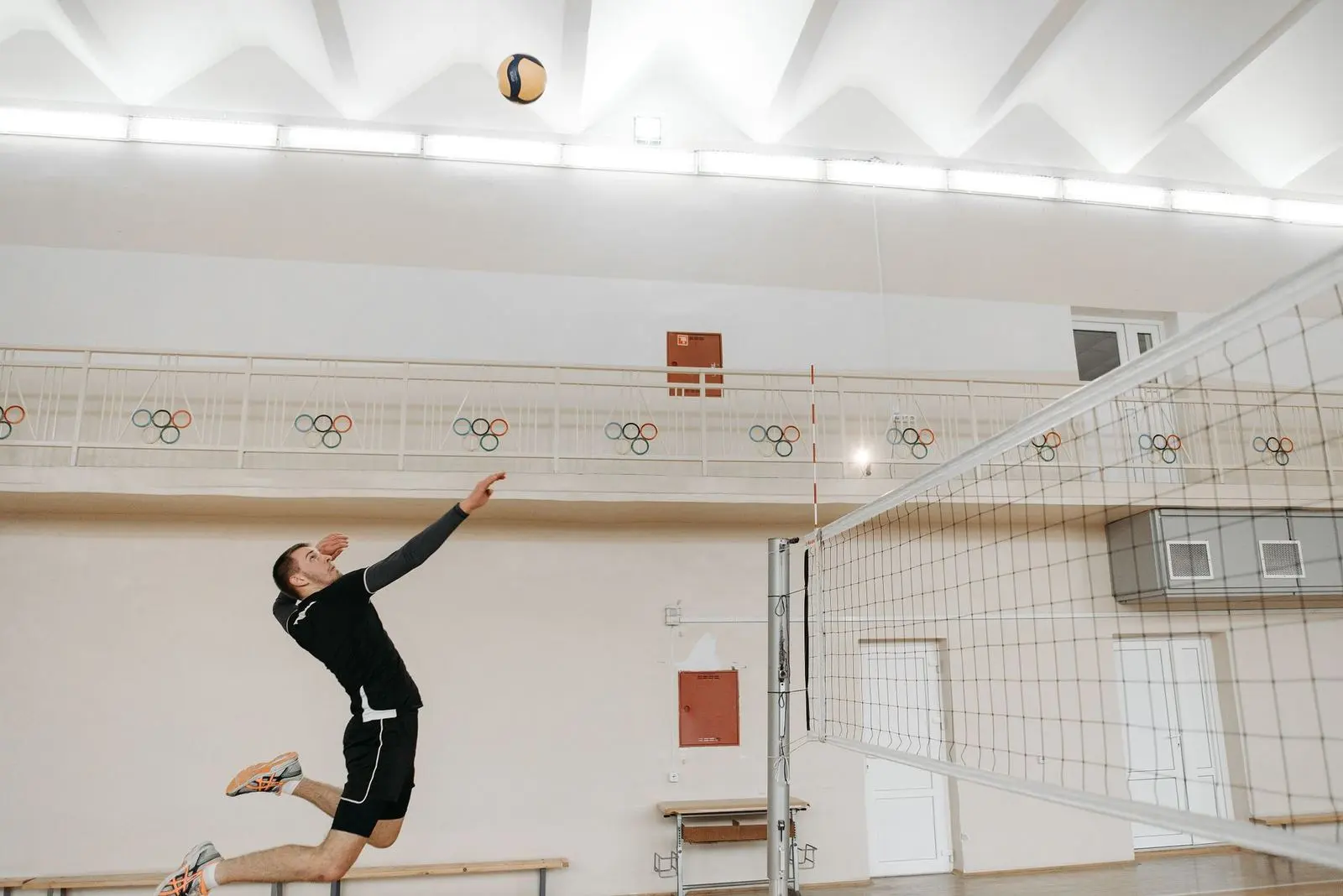
Volleyball World breaks the topspin jump serve into six steps in its tutorial:
- Set-up: hold the ball in your hitting hand and take four large steps back from the end line, then practice running up without stepping over it.
- Toss: toss about 2 meters into the air and 2 meters in front of you, timed so you reach the top of your jump as you hit.
- Approach: use a 3-step approach and finish on the foot opposite your hitting hand.
- Jump: launch off the third step and swing into a bow-and-arrow position.
- Swing: contact the middle of the ball at the top of your reach. Curling the fingers over the top adds topspin.
- Follow through: land balanced on both feet, ready to pass or block.
Coaches do not agree on one toss distance. AVP’s primer suggests 3-5 feet in front of your hitting arm and calls the toss arguably the most crucial part of the serve, so experiment until contact feels natural.
Once the serve is steady, learn how to spike a volleyball to carry the same arm swing to the net. Extra height also improves your contact point, so read how to jump higher for volleyball when you are ready to train it.
Jump float and beach serving tips
A jump float is not a lesser weapon. Head coach John Speraw says in the USA Volleyball feature that on days when your jump serve is off or opponents struggle to pass a float, a simpler, higher-percentage serve is the smart choice. He still wants it hit hard, where you want it, with an error rate lower than 10 percent.
Use these cues to sharpen it:
- Place the toss high enough and far enough in front of you to reach good contact, as Kim Hill says in the USA Volleyball feature.
- Keep the hand flat and let it stop on the ball so it carries no spin.
Outdoors, April Ross says to hit into the wind so the ball moves as much as possible, and to serve from the side the crosswind is coming toward. Because a beach court is shorter, she jumps more straight up and relies on arm speed instead of body momentum. She also controls depth with the swing: follow through to go deeper, or stop the arm on contact to go short (USA Volleyball).
Finally, remember that floats cost less energy, so players often lean on them late in a match when tired, according to Volleyball World.
Frequently asked questions
What is the easiest serve to learn first?
Show answer
Begin underhand. Georgia’s open textbook calls it usually the easiest to learn, so you can practise aiming before you chase power (University of Georgia).
Should I use a float or a jump serve?
Show answer
Pick by the match situation rather than pride. Speraw says a float can be the better choice when your jump serve is off, and USA Volleyball shows he treats it as a real weapon. A jump serve is more tiring, so AVP’s primer notes some players switch to a standing float after a long day.
How high should I toss the ball?
Show answer
It depends on the serve. A standing overhand uses a toss of 3-4 feet above the head (University of Georgia), while a topspin jump serve goes about 2 meters up (Volleyball World).
Where on the ball should my hand land?
Show answer
For a float, aim the middle of your hand at the middle of the ball, as McCutcheon teaches in the USA Volleyball feature. For topspin, Volleyball World says to roll the fingers over the top as you finish, which changes the flight in unexpected ways, in its jump serve tutorial.