
Wondering who stands where? A typical volleyball team lineup puts six players on court: a setter, two centre blockers, two receiver-hitters and a universal spiker, while a libero handles much of the serve reception.
This guide sits within our volleyball league news coverage. It is an independent explainer, not affiliated with any league or federation it mentions, and it does not take registrations or orders.
| Item | Value |
|---|---|
| Players on court per team | Six players |
| Typical starting line-up roles | Setter, two centre blockers, two receiver-hitters, universal spiker |
| Players who can spike or block near the net | The three players at the net positions |
| Line separating front and back court | The three-metre line |
| International substitutions | 6 per set for each team |
| Domestic substitutions (USA Volleyball) | Up to 12 substitutions per set for each team |
These figures come from the FIVB basic rules and the USA Volleyball rules page. They can change, so check the sources before you rely on them.
Who plays where in a volleyball team lineup
Each team puts six players on the court at once, and the FIVB basic rules say most teams build their starting line-up from one familiar set of roles. Think of the lineup as a division of labour rather than six interchangeable bodies.
- Setter: the player who decides which hitter gets the ball.
- Two centre blockers: the players positioned to stop the opponent’s spike at the net.
- Two receiver-hitters: the role name pairs receiving serve with attacking.
- Universal spiker: the sixth starter, an additional attacking option.
The FIVB describes volleyball as a very specialised sport, and adds that players also hold specialist positions for attack and defence. That is why a lineup sheet tells you far more than a simple head count.
One more name belongs in the picture. The FIVB glossary says the libero handles much of the team’s serve reception and is pivotal in backcourt defence.
Front row, back row and the attack line
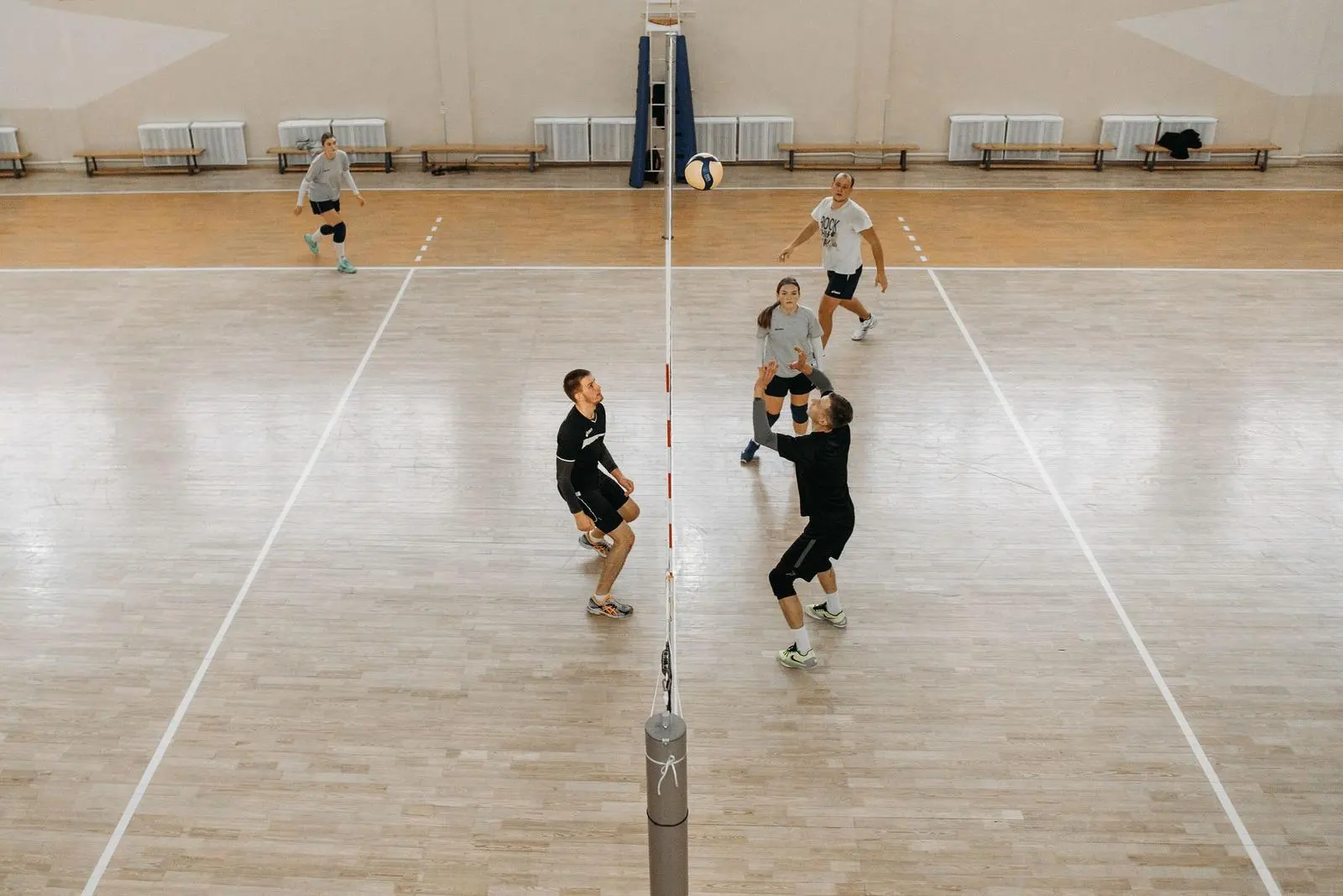
Court position decides what a player may do. Only the three players at the net positions can jump and spike or block near the net, according to the FIVB basic rules.
Players in the back can still attack, but with a condition. They may hit the ball over the net only if they jump from behind the attack line, also known as the three-metre line, which separates the front and back part of the court.
Blocking is a shared job as well: the FIVB glossary notes that the three front-court players share it. So the coach’s choice of who stands in the front row also shapes the team’s wall at the net.
How rotation reshapes the lineup
A lineup is not frozen once play starts. The FIVB basic rules say each player must rotate one position clockwise every time the team wins back service from the opposition.
The FIVB glossary states the other side of it: a serving team that loses a rally loses the right to serve, and the receiving team then rotates one position on the court.
Put together, a rally ends like this:
- The team that wins the rally scores a point, because of the rally point system.
- If the receiving team won, it gains the right to serve.
- Its players then rotate one position clockwise, so a former back-row player may move to the net.
USA Volleyball adds that players rotate clockwise in a set order. In practice, that means the order on the lineup sheet matters from the first serve.
From dig to spike: how the roles connect
A team has three hits to return the ball, not counting the block contact, as the FIVB basic rules explain. The usual pattern gives each lineup role a clear moment:
- The dig, a forearm pass, is usually the first contact and sends the ball toward the setter at the net.
- The set, an overhead pass, is usually the second contact.
- The spike is the hit that sends the ball across the net, and the glossary calls it the most effective way to win a rally.
The FIVB glossary calls setting the tactical centre of volleyball. It adds that the setter must feed the best hitters while looking for weaknesses in the opponent’s block, such as a short player on the front line or a slow centre blocker.
That explains why a lineup is more than a list of names. Who stands opposite whom at the net can change which hitter the setter chooses.
Substitutions and changing your lineup
Coaches rarely keep the same six for a whole match, and the limits depend on the rulebook. USA Volleyball says the primary differences in rules internationally concern substitutions, as set out on its rules page.
- Under international rules, substitutions are limited to 6 per set for each team.
- Under those rules, a substitute can replace a starting-lineup player only once per set.
- Under domestic rules in the United States, up to 12 substitutions are permitted per set for each team, with no limit on replacing starters.
USA Volleyball also notes that the specific rules vary within the United States. Check the rulebook for your own competition before you plan a rotation of reserves.
Limits like these are one reason it pays to follow volleyball rule changes, since a tweak to substitutions alters how a coach builds a lineup.
Reading a lineup announcement
When a team publishes its lineup, a short checklist helps you see what the coach intends:
- Is a setter named, and who plays opposite the setter in the rotation?
- Which two players are the centre blockers?
- Which two receiver-hitters and which universal spiker will attack?
- Is a libero listed to cover serve reception?
- Does the order match the clockwise rotation you expect?
Match reports and previews often lean on these details. If you follow knockout rounds, our explainer on the volleyball playoffs format shows how those matches are structured.
Frequently asked questions
How many players are in a volleyball team lineup?
Show answer
A side fields six at a time, split between the front and the back of the court. Reserves wait to come on under whatever substitution limits your competition sets.
What does the setter do?
Show answer
The setter normally takes the second touch, an overhead pass that puts the ball in a good position for the spiker, as the FIVB glossary describes.
Can back-row players spike?
Show answer
They can attack only by taking off from behind the three-metre line. Players at the net are the ones who can jump and spike close to it, per the FIVB basic rules.
Is this page an official lineup source?
Show answer
No. It is an independent explainer, so rely on your own competition’s rules and team announcements for the actual lineup you need.