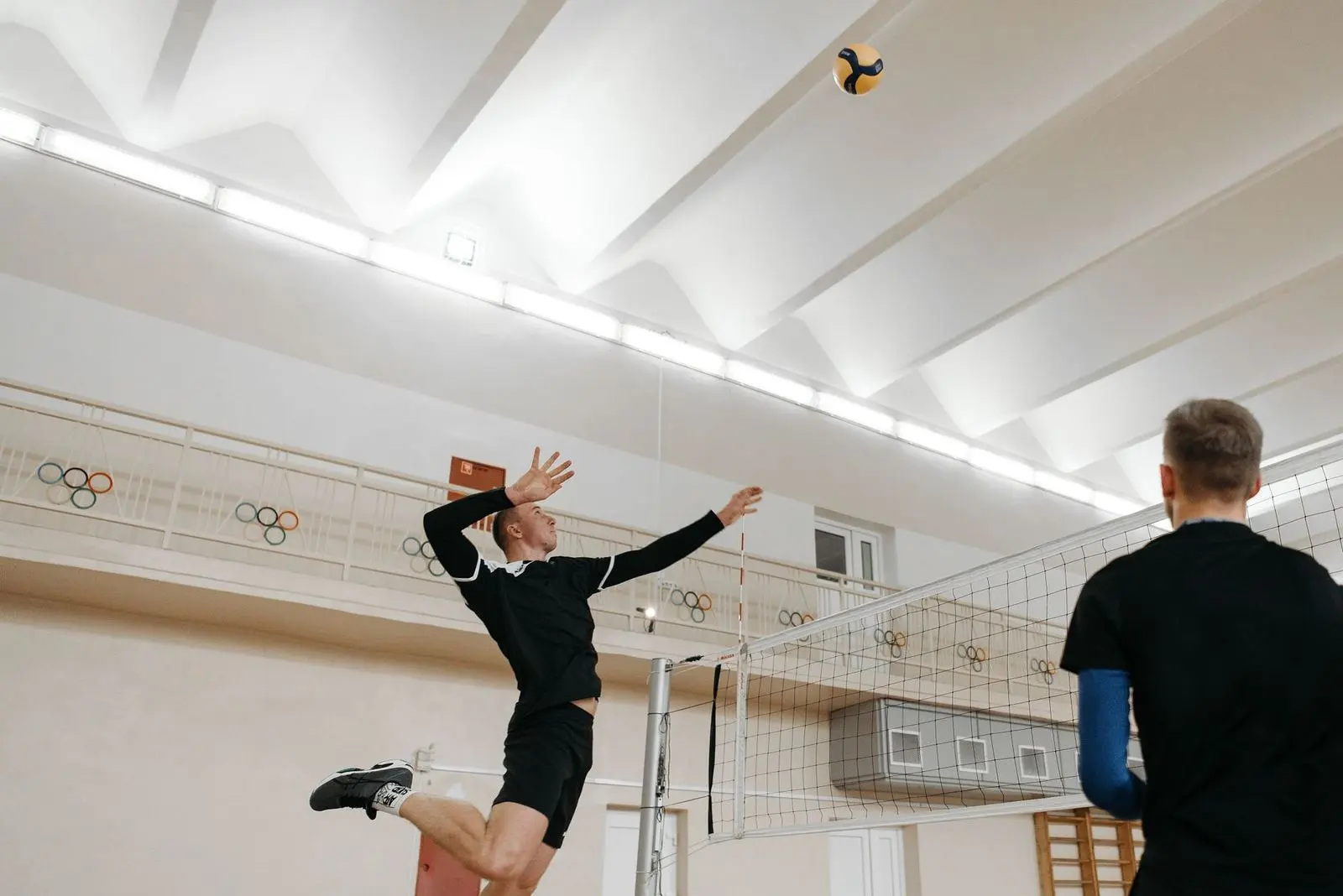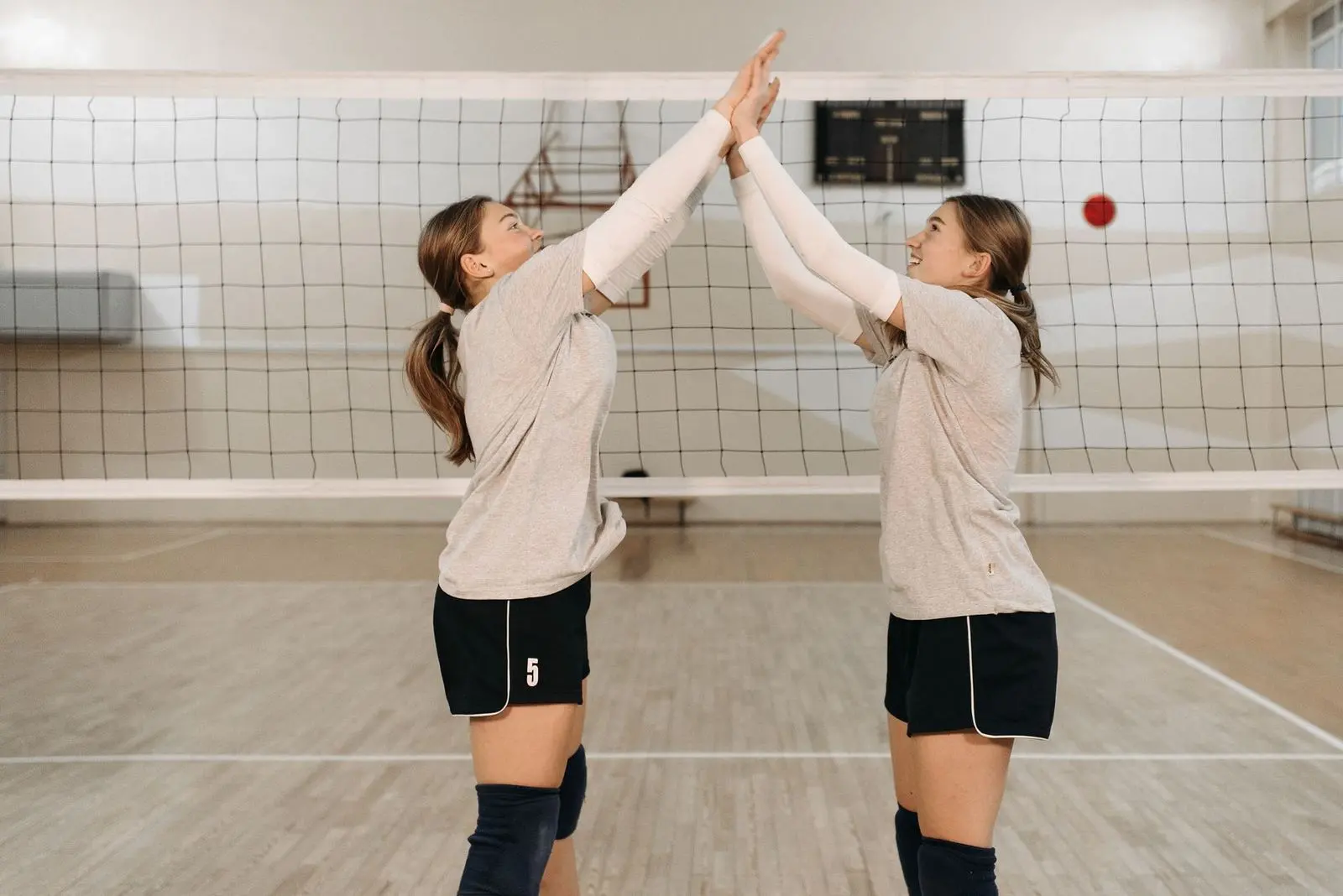
Watching a match and wondering who does what? Volleyball positions explained simply: the setter runs the offense, hitters score, middle blockers guard the net, and the libero anchors the defense.
Browse more volleyball player profiles to see how these roles look in real careers.
| Item | Value |
|---|---|
| Players per indoor team on court | Six players |
| Players per side in beach volleyball | Two players |
| Front-row players who may block and attack | Three players |
| Permitted touches per team | Three touches |
| Attack line that back-row spikers stay behind | 10 feet from the net |
| Libero uniform | Different colour from the rest of the team |
These figures come from CEV’s game overview and Active.com’s position breakdown. Rules and wording can change, so check the source before you rely on them.
How the court and rotation work
An indoor team puts six players on the court, with a net separating the two sides, according to CEV’s overview of the game.
Three of those players form the front row, and Active.com says three front-row players are allowed to block the opponent and attack the ball by spiking it across the net. The rest of the team plays the back row, where the job is defense.
Players do not stay put. Active.com’s position breakdown says that after a team wins possession from the opponent, all six players rotate once clockwise. The court spots they cycle through are:
- Left front
- Middle front
- Right front
- Right back
- Middle back
- Left back
Back-row players dig opponent attacks and can still attack by spiking, but the same Active.com guide says they must stay behind the attack line, which sits 10 feet from the net. Players must also be in the correct rotational order before moving to the net just after the serve. That rule is why a player’s rotation spot shapes what they can do on any given rally.
The setter: the team’s playmaker
The setter is the position coaches most often compare to a quarterback. Active.com describes the setter as running the offense with controlled sets, and Dick’s Sporting Goods adds that the setter aims to take the second touch and set it for an attacker.
The job is as much thinking as touching. UNBC’s positions page says the setter calls all the plays and usually needs to be a leader on the team. CEV adds that a setter must feed the best hitters while hunting for blocking weaknesses on the other side.
In short, a good setter usually:
- Runs the offense and decides who gets the ball
- Delivers the second touch to a hitter
- Communicates the play to teammates
- Reads the opposing blockers for the weakest one
Because setters can play front or back row, they must also be ready to block, dig and receive a serve, per Dick’s. ActiveSG Circle adds that setters must communicate the play and the type of set to teammates. If the playmaking role interests you most, the guide on what does a setter do in volleyball goes deeper.
Outside and opposite hitters
The outside hitter, also known as the left-side hitter, attacks from the left antenna and needs strong jumping ability, says Dick’s Sporting Goods. The same guide calls this player the focal point of the offense, completing most of the attack hits. On defense, outside hitters often receive the serve.
The opposite hitter lines up opposite the setter and attacks through the right side of the court, according to CEV. CEV also notes it is quite common for this player to be the main attacking outlet and to score the most points in a match.
Dick’s adds that opposite hitters tend to be the most versatile players, strong on both offense and defense. They also need to be ready to set the ball if the setter cannot do it. If you like following one star’s career rather than a role in general, read about yuji nishida volleyball on our player pages.
Middle blockers and the libero
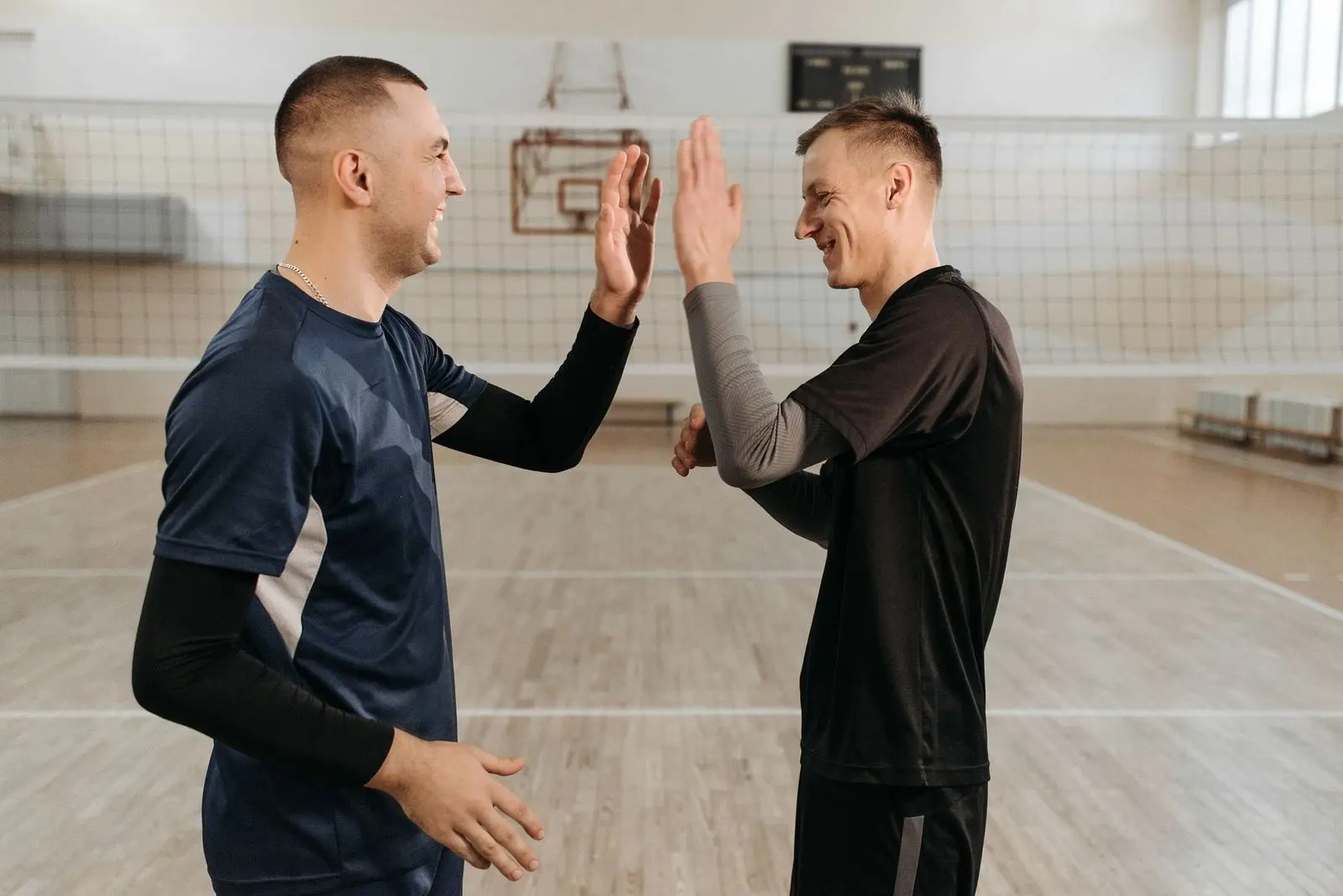
CEV calls the middle blocker the unsung hero of the team. Their main job is to move with the opposing set so the team can present a double block, or even a triple block, across the whole net, per CEV.
Active.com says this is usually the tallest person on the team, moving along the front line to block almost every hit. On offense, ActiveSG Circle says the middle blocker hits quick sets or acts as a decoy to confuse the opposing blockers.
The libero is the defensive specialist who stands out in a different coloured uniform and can be substituted in the backcourt for any teammate, according to CEV. Active.com says the libero rarely comes close to the net and is usually the shortest player on the team.
Rules for this role can vary by competition. CEV states that the libero cannot serve, spike the ball over the net or rotate into the front line, while ActiveSG Circle describes liberos as defensive players who receive or serve. Check your own league’s rulebook before you assume either version.
Specialists and beach volleyball roles
Beyond the core positions, teams sometimes use specialists, as Volleyball World describes:
- Defensive specialist: plays much like the libero, returning and setting fast-moving balls, but wears the same colour as teammates and follows normal substitution rules.
- Serving specialist: rotates in because of a very hard-to-return or consistent serve.
Beach volleyball strips the roles back. Because there are only two players per side, each must block and defend, though the taller player usually works at the net while the more agile partner covers the backcourt, according to Volleyball World.
That guide also stresses that communication is crucial on sand. Two players diving for the same ball can cause injury or leave the court wide open.
How a point comes together
Roles make most sense when you watch them work in sequence. Volleyball World says the defender typically stops the serve with a gentle return to the setter or middle blocker. The setter then creates the perfect angle for the outside or opposite hitter to spike into the opponent’s court, as described by Volleyball World.
Using all three permitted touches slows the game down and gives players time to reach the right spot. Next time you watch a rally, try to name each player’s role at each touch. This guide is independent and is not an official league page.
Frequently asked questions
How many people play on a volleyball court at once?
Show answer
In indoor play each side fields six, a count given by CEV. On sand, each side has just two players, per Volleyball World.
What separates an outside hitter from an opposite hitter?
Show answer
Mostly the side of the net they attack from. Per Dick’s Sporting Goods, the outside hitter works the left antenna, while the opposite hitter plays near the right antenna and may double as a backup setter.
Which position suits a shorter player?
Show answer
CEV says the libero is a position more suited to shorter players, who tend to be faster and more agile. You can read that in CEV’s description of the positions.
Can back-row players spike?
Show answer
Yes, with a limit. As Active.com explains, they have to take the attack from behind the line that sits 10 feet from the net.